I’m going to post soon on the Robbins (2012) Political Ecology text, but I recently added the use of the four-sentence rhetorical précis format to my reading workflow, and I wanted to talk about that. Margaret K. Woodworth, an English professor, developed the format in the late 1980s for use in her courses. It forces the reader to distinguish the argument from the purpose, methods, and audience.
The idea is this:
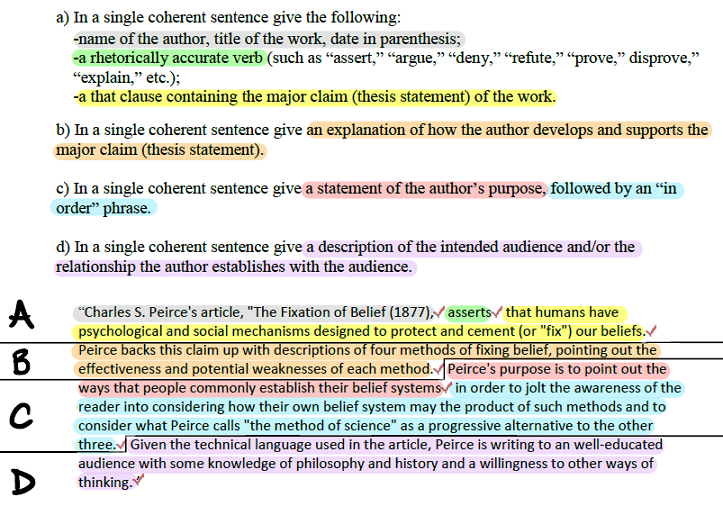
It seems formulaic and reductive, but it has done things for my comprehension and reading speed. I attack my skimming, and a little more intense reading, with filling in this “form” in mind, and emerge with a much more cogent picture of an article or chapter, and in much less time, than I was before.
I’m still getting a little lost in the more interesting ones, of course. My fatal flaw. I am fudging it a bit – the précis, as imagined by Woodworth, calls for close reading. But I don’t have time. So, I’m shortchanging the form, but it’s been a helpful remedy to my distaste and distrust of the AIC method – reading the abstract, introduction, and conclusion alone.
It’s had an interesting consequence for this blog, the purpose of which was to “write myself through” the understanding of my field statement and other comps reading. Well, the précis is doing that, and I’m leery of doubling up on writing that isn’t the actual field statement that I need to be writing. I guess that leaves the blog as my ventilation file (a la the indispensable Jensen), whether about process, pieces, personal parenthesis, pedagogy, or other parts potpourri.
 MY BARBARIC MAUP